


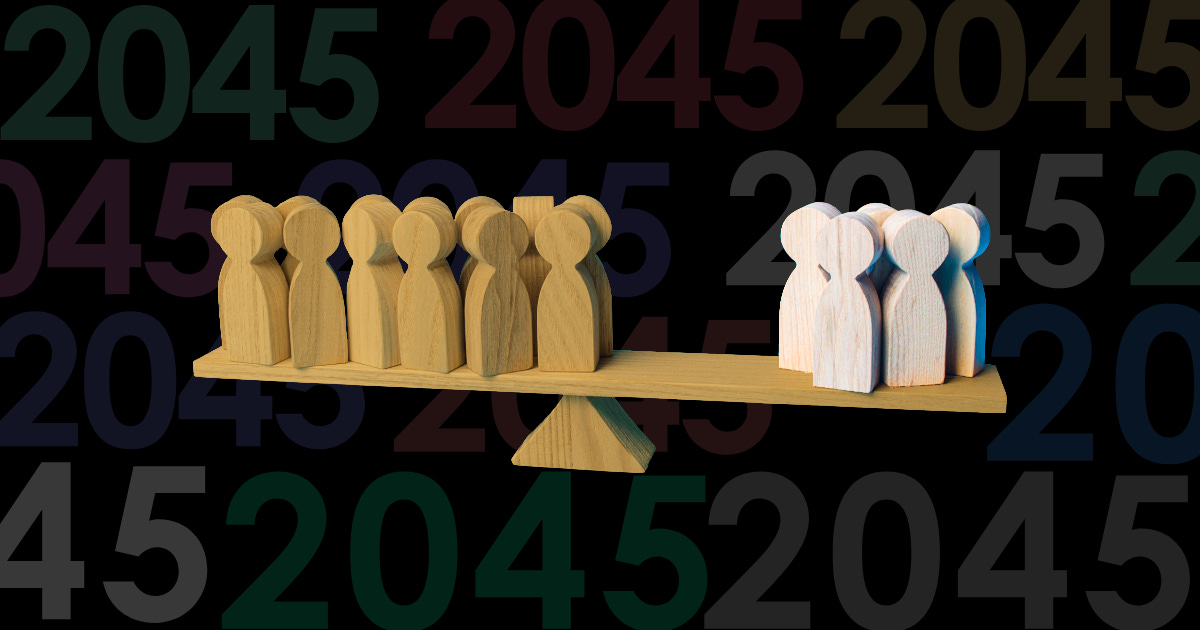
Project 2045 is built on an assumption.
Not a certainty. Not a guarantee. But a conviction shaped by experience, listening, and years of watching how people actually live their lives rather than how they perform online.
The assumption is this:
There are a lot of white people in America who genuinely believe that we can flourish together in a future shaped by racial and cultural difference. God, I hope I am right.
This isn’t a fringe position. And it isn’t a timid one.
I wouldn’t describe it as a “middle space” between progressive and conservative. That language still assumes the poles are the most important thing in the room. I think this is closer to a majority space—a wide, often quiet group of people who are ready for the realities of a 2045 world but feel under-equipped to engage it now.
They are not apathetic. They are not hostile. But they are hesitant.
Not because they don’t care, but because the public conversation has trained them to believe that unless you are perfectly fluent, fully updated, and ideologically precise, you should probably stay quiet.
So many people sense where the country is headed demographically. They understand what 2045 represents. They don’t experience that future as a loss. They imagine it as something that could be good—something expansive, even hopeful. And yet, when it comes to talking about race, culture, and difference, that internal clarity collapses into external silence.
Because wanting to flourish together is not the same thing as knowing how to talk about it and knowing how we get there.
The Confidence Gap
Another assumption I’m working from is this:
Many people lack both the competence and the confidence to articulate what they want to be a reality about race in a polarized society.
They feel it intuitively. They live it relationally. But they don’t know how to say it out loud without fear of retaliation or misstep. They worry about using the wrong language. About relying on outdated terms. About being exposed as unenlightened or behind.
So instead of learning publicly, they retreat privately.
Meanwhile, the loudest voices in the room are often those who don’t want a society where we all flourish together across difference. Some of them, backed by a long history of structural inequality, are quite confident that we cannot flourish together. For those voices, 2045 isn’t just a date. It’s a threat.
And when those voices dominate the conversation, everyone else learns the same lesson:
Better to stay quiet than get it wrong.
What Racism Has Stolen From Us
Racism embedded in society hasn’t only harmed communities of color. It has also robbed all of us of the practice required to become a people committed to mutual flourishing.
It has short-circuited our capacity for honest learning. It has turned curiosity into risk. It has replaced doing this work together with performance.
So when people cautiously step toward the conversation. They’re often met with a temperature that is too high for growth. The pressure to be right overwhelms the opportunity to become more capable.
That doesn’t mean accountability doesn’t matter. It does. But accountability without space for learning creates fear, not transformation.
Turning Down the Temperature
Project 2045 is grounded in the belief that we need spaces where the temperature is lower—not because the stakes are small, but because the work is long.
Spaces where people can build competence and confidence. Spaces where learning together matters more than fluency. Spaces where we practice talking about race not to win, but to understand.
The future we’re heading toward will require more from us than correct language. It will require resilient relationships, moral imagination, and the ability to stay present in difference without collapsing into silence or defensiveness.
That kind of capacity doesn’t emerge in viral moments where we justifiably turn to outrage. It is formed slowly, together, over time.
This is the assumption I’m working from:
That many people are more ready than they appear. That the desire to flourish together is already here. And that with the right kinds of spaces, conversations, and practices, that desire can grow into something durable enough to carry us into 2045.
This is my hope, this is my assumption. I hope we are more ready than we sometimes appear to be.