


As Project 2045 begins to find a bit of momentum, I’ve noticed something unexpected. I spend a lot of time talking about the things in life that matter most. And almost none of us were ever trained to talk about them well.
That realization keeps showing up in different ways.
I think about how ineffective most of our early attempts at learning were. A sixth-grade sex ed class that barely prepared us for a deeply complex and highly sexualized world. Conversations about politics that quickly collapse into slogans or silence. The quiet shock of being handed a newborn and realizing how little anyone actually prepared you for parenting.
We are living inside some of the most formative, consequential parts of life with almost no shared language, no real practice, and very little guidance. And yet, these are the places that shape us the most.
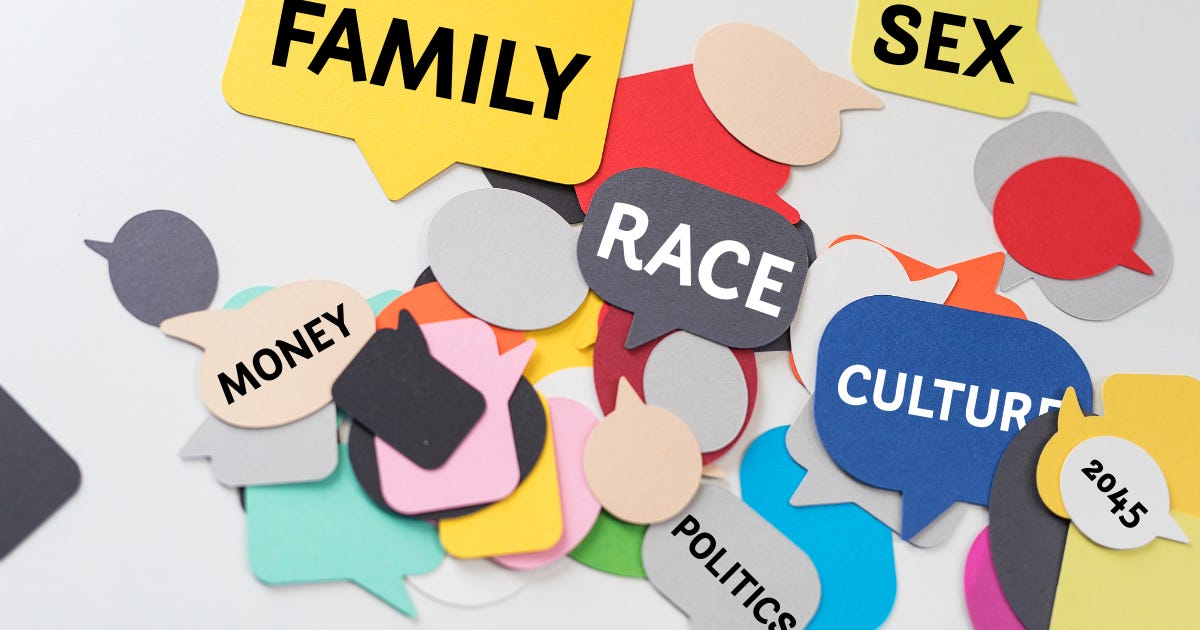
Sex. Money. Family. Race. Culture. Politics.
These are not side topics. These are the terrain of our lives. And still, many of us were taught some version of the same rule: We don’t talk about that. Not here. Not at the table. Not in polite company.
There is something understandable about that instinct. Some experiences can only be learned by living them. No handbook can fully prepare you for everything you will face.
But I am no longer convinced that silence is the best we can do. Because there is a difference between mystery and neglect. There are parts of life that will always be complex. But there are also parts where we have simply failed to develop the skills, language, and confidence we need. And often, that failure is not accidental.
There are spoken and unspoken forces that keep us underdeveloped in these spaces.
Polite culture tells us not to make waves.
Family systems teach us to keep things looking “okay.”
Wider structures benefit when difficult conversations never happen.
Silence, in many cases, protects the status quo. And the status quo does not benefit everyone equally. So the question underneath Project 2045 is not just about race or culture, even though those are central. It is a broader question about our lives.
What would it look like for people to become competent, confident, and even fluent in the areas of life that matter most?
Not perfect. Not having all the answers.
But able to name our own story.
Able to listen to someone else’s experience without immediately reacting.
Able to stay in a conversation long enough for something real to emerge.
Because the goal is not simply to “talk about hard things.”
The goal is to build the kind of capacity that allows us to bridge across difference without collapsing into fear, performance, or avoidance. Race and culture in America are undeniably complex. No single framework is going to resolve that complexity. But that does not mean we are stuck.
We can get better.
We can learn how to locate ourselves in our own stories with honesty.
We can practice listening in ways that create space rather than shut it down.
We can develop language that helps us navigate tension instead of escaping it.
We can become people who are formed enough to engage what is actually in front of us. The alternative is what many of us have already experienced. A life where the most important conversations are the ones we never learned how to have. Project 2045 exists because that does not have to be the case.
And maybe the work in front of us is simpler than we think. Not easier. But simpler.
We start talking.
We learn how to listen.
We practice staying.
And over time, what once felt unspeakable becomes something we can carry together.
So good.