


One of Dr. Martin Luther King Jr.’s most quoted lines comes from his 1963 Letter from Birmingham Jail. Many people can recite the opening phrase from memory: “Injustice anywhere is a threat to justice everywhere.”
We hear that sentence often.
It appears in sermons, speeches, classrooms, and social media posts. It has become a kind of moral shorthand. When something unjust happens somewhere, someone inevitably reaches for those words. But for a long time, that line alone felt a little abstract to me. True, yes. Powerful, yes. But also a little unclear as to what that looks like and what to do about it.
Why exactly is injustice somewhere else a threat to justice where I live? The answer, I eventually realized, comes in the very next sentence of King’s letter.
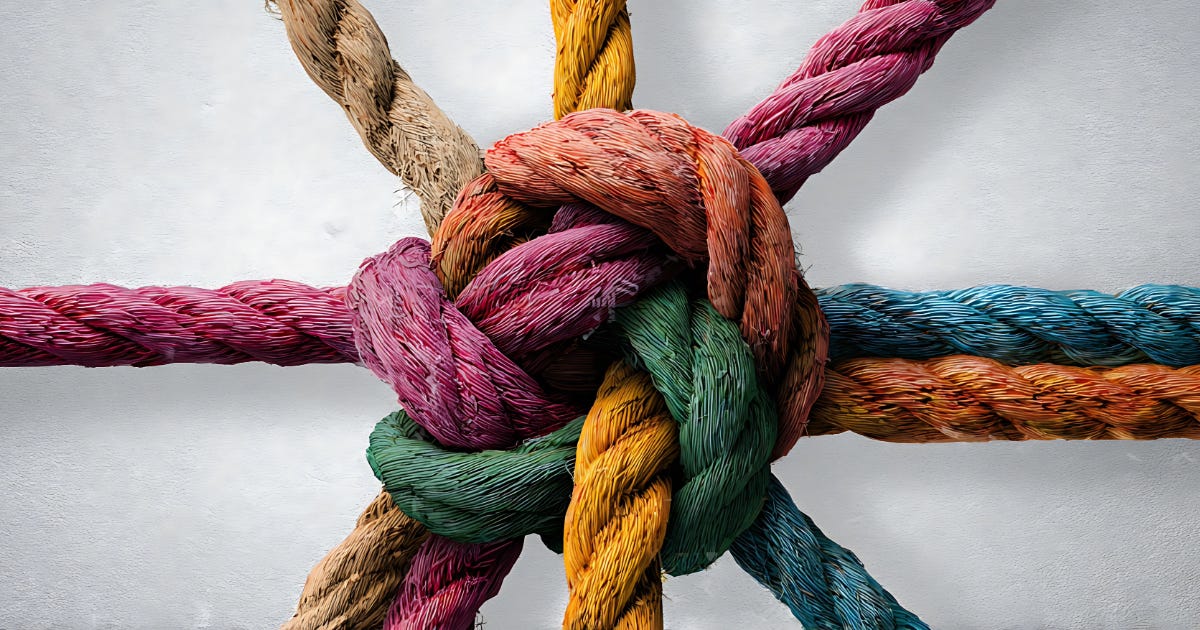
“We are caught in an inescapable network of mutuality, tied in a single garment of destiny. Whatever affects one directly, affects all indirectly.”
King says that we are caught in what he calls a network of mutuality. Our lives are tied together in ways we do not always see. The metaphor is almost like a web. Tug one strand and the vibration travels across the entire structure.
That idea changed how I understood the first line. The point is not simply that injustice is morally wrong wherever it happens. The point is that our lives are structurally connected. We are not separate actors living independent stories. We live inside the same web.
The conditions that shape one community eventually shape others. The rules that advantage one group eventually shape the opportunities available to everyone else, which in turn impacts those with advantage. The stories a society tells about some people eventually influence how it treats others. The web holds all of it.
This is one of the hardest ideas for Americans to fully embrace. Our culture trains us to see ourselves as individuals first. We talk about personal responsibility, personal freedom, and personal success.
Those things matter. But King’s vision insists that our lives are also collective. I am starting to think this is less of a vision and what King was naming was a reality.
The neighborhood you grow up in matters. But the health of the neighborhood matters to a city. The schools available to you matter. But the quality of that education impacts the greater economic progress for all. None of these things exist in isolation. They are strands in the web.
This is why conversations about justice often feel uncomfortable. When we begin to talk honestly about inequality, it is tempting to retreat into individual explanations. People want to know whether they personally did something wrong. But the web of mutuality is not primarily about personal guilt.
It is about shared reality. We inherit systems. We participate in them. And whether we acknowledge it or not, we are shaped by them. Some people experience the web as support. Others experience it as a constraint. Most of us experience some mixture of both.
Consider something as simple as the clothes we wear. A shirt that sells for $20 at a store often reflects a chain of decisions made across several countries. The garment worker who sewed it may earn very little for that labor. The factory owner is under pressure to keep costs low to stay competitive. The brand profits by maintaining a price point consumers will accept.
For the shopper, the result is inexpensive clothing. For the worker, the result may be wages that barely support a family. For the company, the system keeps products moving and profits stable.
Each person in the chain experiences the outcome differently. Yet they are connected through the same system. The comfort of one part of the web often rests on the strain placed somewhere else along it.
Housing markets reveal the same web. Recently, the President of the United States declared that he does not want home prices to go down because that will have a negative impact on the wealthy. That is a vision of the world that is not taking into account the network of mutuality. When home prices rise faster than incomes, the effects are not the same for everyone.
For someone who already owns a home, rising prices can mean growing wealth. Their property becomes more valuable. Equity builds. Financial security increases. For someone trying to buy their first home, those same rising prices can push ownership further out of reach. Down payments grow larger. Mortgage payments become harder to qualify for. Many remain renters longer than they expected.
For renters, higher home values often translate into higher rents as well. More of their income goes toward housing, leaving less to save or invest. The same housing market creates stability and wealth for some while creating pressure and uncertainty for others. As a homeowner I would rather see prices go down, more people be able to get into ownership, generational wealth built for the sake of healthier familes and neighborhoods.
One strand moves, and different lives move with it.
We could cite examples in so many other areas. At some point, every conversation about justice runs into a quiet question.
Why should I care?
Not in a cynical way. In an honest way. People want to know what this has to do with their lives. Dr. King’s idea of the web of mutuality answers that question in a surprising way. It says that caring about justice is not only about helping someone else. It is also about the kind of world you yourself get to live in.
When the web is healthier, life improves for everyone. Communities with stable housing are safer communities. Schools with more opportunity produce stronger local economies. Healthcare systems that serve everyone reduce costs and strain for all of us. Workplaces that treat people fairly create more sustainable businesses.
The web of mutuality means that flourishing is rarely isolated. When opportunity expands, innovation grows. When communities trust each other, cooperation increases. When people feel seen and valued, they contribute more fully to the common life.
The opposite is also true. When the web is strained—when inequality grows, when opportunity narrows, when distrust spreads—those pressures eventually touch everyone.
No one gets to live completely outside the web. Even if there are forces at work to hide the web from us or teach us that it doesn’t actually exist. So the question is not only whether we care about justice for someone else. The deeper question is what kind of world wide web we want to live inside.
A fraying one built on separation and scarcity. Or a stronger one where more people can flourish.
Dr. King believed our lives were tied together, whether we acknowledged it or not. The work of justice is simply learning how to live responsibly inside that reality. Because in the end, caring about the web of mutuality is not just about changing the world. It is about recognizing that the world we help shape is also the world we ourselves must inhabit.
The work of justice is not pretending the web doesn’t exist. The work is learning how to repair it. For those of us doing the work of Project 2045, this idea sits at the center of the conversation. We are trying to tell the truth about the web we inherited. We are trying to understand how its strands were woven. And we are asking what responsibility we have for the parts of the web we now hold.
Because once you see the web, you cannot unsee it. And once you recognize that your life is tied to the lives of others, the question changes. It is no longer simply: What is happening to them? The question becomes:
What kind of web are we weaving together now?