


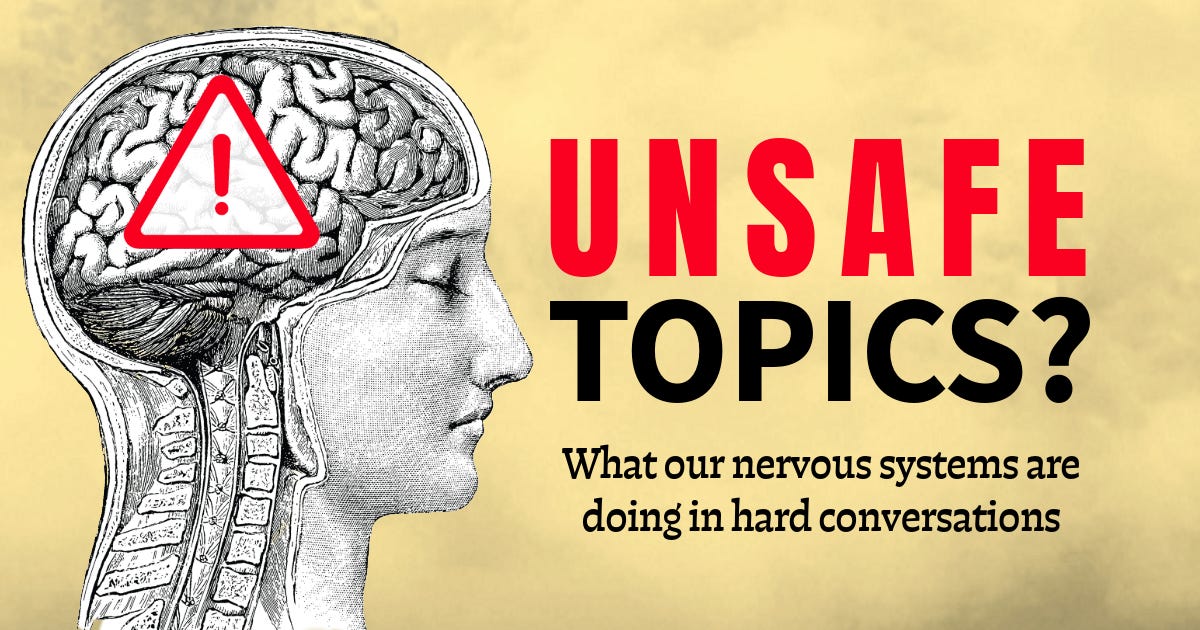
One of the more unsurprising discoveries from our first Project 2045 pilot cohort was how many people carried the same implicit message about race from childhood:
This is dangerous territory.
Not necessarily because someone sat us down and said those exact words. In many cases, nobody had to. The lesson was communicated indirectly through tension, avoidance, silence, warnings, jokes, sudden changes in tone, or the visible discomfort of adults whenever race emerged in conversation.
For many of us, race became associated with volatility long before we developed the language to describe what we were experiencing. We learned that these conversations could rupture relationships, embarrass families, expose ignorance, provoke conflict, or get someone labeled as racist, angry, divisive, naïve, or oversensitive. So many people internalized the same basic instinct: better to avoid it.
And avoidance makes sense when your nervous system has learned something is unsafe.
One of the problems with conversations about race is that many people think the primary challenge is intellectual disagreement. Sometimes it is. But often the deeper challenge is physiological before it is ideological.
Our bodies react before our carefully constructed thoughts do.
We can feel it happen in ourselves in real time if we are paying attention. Our breathing changes. Our shoulders tighten. Our faces grow warm. Our heart rate increases. Our thoughts begin speeding up and we quietly stop listening as carefully as we were a moment before. Instead of curiosity, we begin preparing defenses, explanations, rebuttals, or escape routes. Sometimes we become argumentative. Sometimes we shut down completely. Sometimes we overexplain, rush toward reassurance, or become hyperaware of possible judgment or rejection. Much of the time, we think we are simply having a conversation, when in reality our nervous systems have already started responding as if we are under threat.
In other words, many of us are not just having conversations. We are managing perceived threats. And if we do not understand that dynamic, we often moralize reactions that are at least partially physiological.
This does not mean every feeling should govern the conversation. It does not mean discomfort is inherently harmful. It does not mean accountability disappears. But it does mean that understanding our nervous systems matters if we actually want better conversations instead of endlessly repeated cycles of fear and defensiveness.
Part of maturity is learning to notice what is happening inside us without immediately obeying it. That is harder than it sounds. Especially because many of us inherited almost no tools for staying grounded in difficult conversations. We inherited either avoidance or escalation. Silence or explosion. Performative certainty or total withdrawal.
Very few people were taught how to remain regulated while discussing subjects tied to identity, history, morality, belonging, or pain. And yet that capacity may become increasingly necessary in the years ahead.
The demographic and cultural changes happening in America are not slowing down. We are going to live, work, worship, vote, raise children, and build communities alongside people with different histories, assumptions, experiences, and fears. If our nervous systems interpret every difficult conversation as existential danger, we will continue retreating into smaller and smaller tribes where we feel temporarily safe and permanently disconnected.
This is part of why slowing down matters.
Not because slowing down magically solves conflict, but because speed often intensifies nervous system reactions. Fast conversations reward certainty, performance, and reaction. Slow conversations create more room to notice what is happening internally before we immediately externalize it onto everyone else.
Sometimes growth begins with something as simple as recognizing what is happening inside us in the middle of a conversation. We notice that our chest tightened when a certain topic came up. We realize we suddenly became defensive or stopped listening carefully. Maybe we felt embarrassed, wanted to escape, wanted to win the conversation, or wanted reassurance that we were still a good person. Those observations may seem small, but they are often the beginning of self-awareness instead of automatic reaction.
Those observations may sound small, but they are often the beginning of self-awareness instead of automatic reaction.
And honestly, I think many of us need permission to realize that struggling in these conversations does not automatically mean we are bad people. It may simply mean we are human beings attempting to unlearn years of fear, avoidance, tribal conditioning, and inherited anxiety around subjects we were rarely taught how to navigate well.
The goal is not becoming emotionless. The goal is becoming more aware, more grounded, and more capable of staying present long enough for real understanding to emerge.