


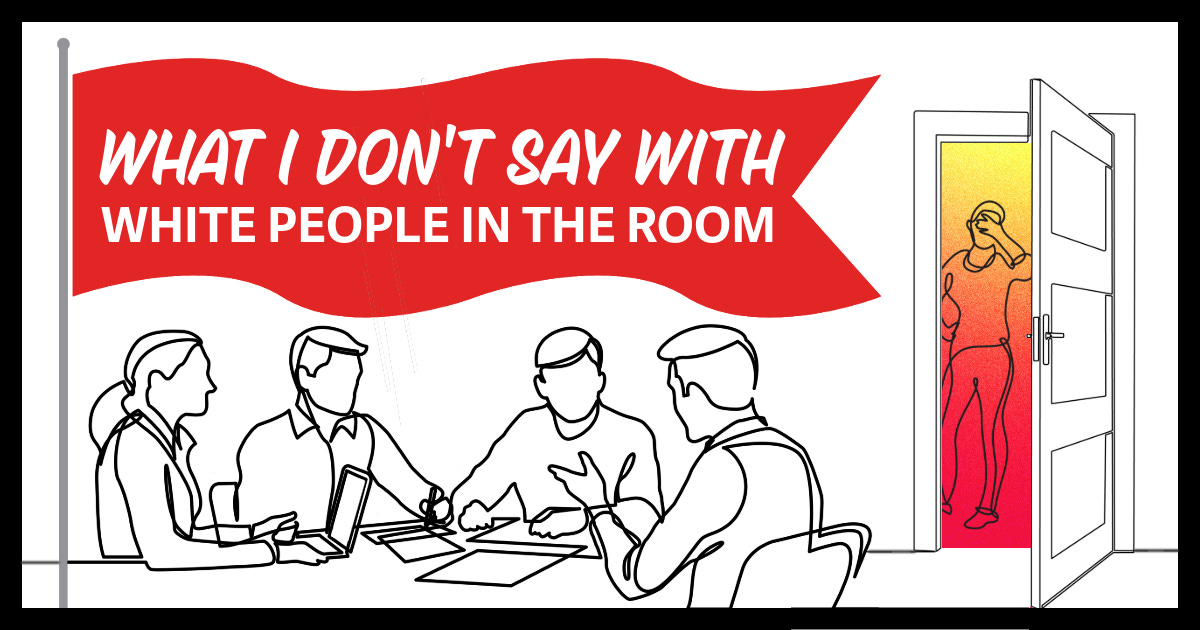
There are things I do not say when white people are in the room. Not because I lack words. I just wonder, if it is worth it.
Is it worth the energy I’ll expend calculating how honest I can be before somebody becomes defensive? Is it worth the time I’ll take to choose my words carefully so that we avoid exposing someone’s fragility? Is it worth the relational capital I’ll spend naming what just happened and possibly derailing the entire room? There’s an emotional cost to explaining, contextualizing, reassuring, clarifying, comforting, and educating - and some days that cost feels very expensive.
So sometimes I just let things go.
I let somebody interrupt me.
I let somebody explain my own experience back to me.
I let somebody assume agreement instead of asking for it.
I let comments slide that I would absolutely push back on in another setting.
Because sometimes getting through the meeting matters more than honesty. And that is the part many white people do not understand. They think silence means agreement. They think professionalism means comfort. They think the meeting “went well” because nobody openly challenged anything.
Meanwhile, I am sitting there making real-time decisions about whether honesty is emotionally safe, strategically useful, or simply too expensive.
Sometimes I disengage completely. Not visibly. I know how to stay in the room. I know how to nod. I know how to participate enough. I know how to survive professionally. But internally, I may have already left the room. When there’s no time for honesty, curiosity, slowness, or accountability; when everything has to move quickly, stay productive, and stay on schedule, I begin to question whether I should bring my full self into the meeting.
My white colleagues often say they want honesty, but honesty takes time. It’s taken me years to realize it, but when everything has to stay fast, efficient, polished, and on schedule, it’s an indication that honesty is probably not a priority. And all the things that emerge with and on the other side of honesty takes time. Real listening takes time. Repair takes time. Accountability takes time. True relationship takes time.
A lot of white people say they want honesty, but what they really want is confirmation delivered through a different voice. They want a Black or brown person to echo what they already think in language that feels just challenging enough to be interesting but not disruptive enough to require change. And often what white institutions want is diversity without disruption. They want my presence. They do not always want my perspective.
My honesty is disruptive. And I’m not going to apologize for it. I know it’s not always welcome. I know it’s inconvenient and slows things down. And I know that I am not always right. I also know, more times than not, my feedback and perspective is helpful.
So I’ll hold back. I’ll measure my responses. I’ll choose my words. I’ll do a ton of work to avoid telling my colleagues the truth. Cuz no one likes the black contrarian. Truth is, when I avoid the cost of being honest, it actually costs my white colleagues more. When I can’t bring my honesty, I can’t be in true relationship with you.
I was thinking recently about my brother who passed away a few years ago. One of the things I miss most about him is our fights. The wrestling. The arguing. The times when the honesty led to anger. Pushing each other. The intensity.
We loved each other enough to be honest, and that honesty led to conflict. But the conflict was never meant to destroy each other. The conflict was the mechanism that would lead to resolution. Without the conflict, boundaries were never addressed. Without relational rupture, we would never have learned accountability and repair. Without pushing back, we would not know each other’s vulnerabilities and be able to respond with care. We fought because we were real with each other.
And honestly, that is part of what I sometimes want with white people too. Not politeness or diplomacy. Certainly, not careful corporate language.
Realness.
Sometimes I say “whiteness” sharply because I want to see if you can stay in the conversation. Sometimes I push because I want to know whether you can handle honesty without collapsing into defensiveness or guilt or withdrawal.
Because the truth is: The people I love, I fight. The people I trust, are the people I feel safest push back on. When I believe in you, I risk honesty with you. And sometimes what whiteness, institutions, and racial systems have stolen from us is the ability to actually struggle honestly with one another without treating conflict itself as failure.
Some white people experience any discomfort as rejection, hostility, or unfairness. But many of us learned long ago how to lose small things every day and keep functioning. We learned how to stay at the table without being centered. We learned how to absorb discomfort without making it everybody else’s emergency.
Sometimes I want white people to learn that too.
I want them to lose an argument and survive it.
I want them to be uncomfortable and survive it.
I want them to not be centered for a moment and survive it.
Because maybe then we could finally become real with each other. And honestly, I think many of us are starving for relationships where we no longer have to manage white comfort in order to tell the truth.
—————————————————————————————
We are grateful to our guest writer for illuminating this dynamic in What I Can’t Say With White People in the Room. Project 2045 will periodically publish reflections—many anonymous—on this topic from Writers of Color