



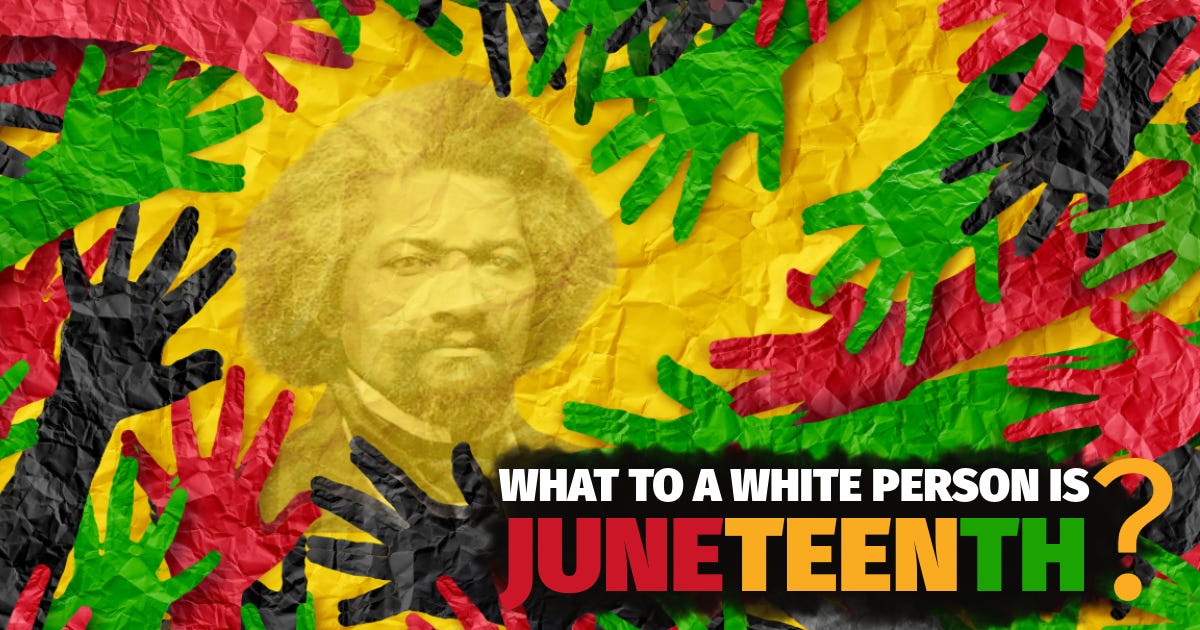
Next week, I am attending a webinar from Faith 250 on Frederick Douglass’s famous speech, What to the Slave Is the Fourth of July?
In that landmark 1852 address, Douglass challenged the nation to confront the contradiction between its celebration of liberty and the ongoing reality of slavery. Rather than rejecting the ideals of the Fourth of July, Douglass called America to live up to its own promises of freedom, justice, and human dignity for all people.
Thinking about the webinar has inspired me to ask a different question:
What to a white person is Juneteenth?
Before answering that question, it helps to remember what Juneteenth is.
Juneteenth commemorates June 19, 1865, the day enslaved people in Texas learned they were free, more than two years after the issuance of the Emancipation Proclamation. On that day, Union troops arrived in Galveston and announced the end of slavery, marking a significant moment in the nation’s long journey toward freedom. Over time, Juneteenth became a celebration of Black resilience, culture, community, and the ongoing pursuit of justice and equality. In 2021, Juneteenth was officially recognized as a federal holiday in the United States, inviting all Americans to reflect on both the progress made and the work that remains.
Three times in the last few years I have visited Galveston, Texas, the birthplace of Juneteenth. I have stood before the incredible mural that tells the story. I have visited the art gallery housed in the historic building. I have listened to the Sam Collins II, Professor Juneteenth, explain the significance of the site and the history it preserves.
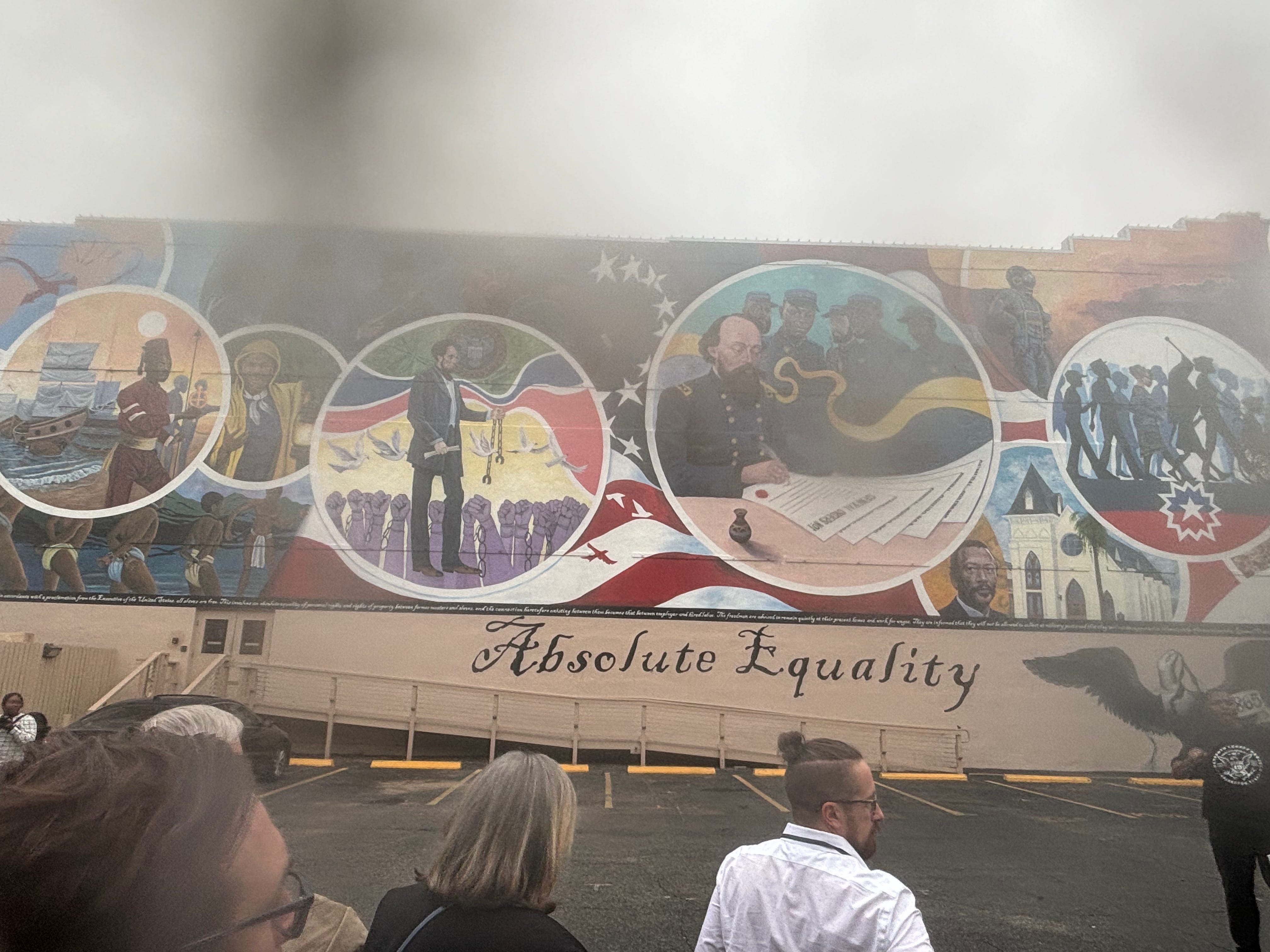
What stands out to me every time is the power of public history.
The space itself tells a story. Across the street stands one of the largest slave auction sites in Texas. The distance between those two places is measured in steps, but it represents generations of struggle, suffering, courage, and change. The experience reminded me that history is not just something we read in books. History lives in places. It lives in stories. It lives in what we choose to remember and what we choose to forget.
That is one of the gifts of Juneteenth. It makes history accessible. It invites us into stories that many of us were never taught. It helps us understand not only what happened, but why it matters.
When Juneteenth became a federal holiday in 2021, some rightly questioned whether symbolic recognition was enough. The critique was familiar and important. Malcolm X once warned, “The white man will try to satisfy us with symbolic victories rather than economic equity and real justice.”
That critique remains a necessary measure of our justice efforts. Symbolic victories alone are not enough.
And yet, I find myself increasingly grateful for Juneteenth. Not because a holiday solves injustice, but because remembrance matters.
In a moment when we are seeing active efforts to erase, minimize, and inaccurately rewrite parts of our nation’s history around race and racism, spaces of public memory become even more important. This very week, a federal appeals court ruled that the Trump administration can replace slavery-related exhibits at Philadelphia’s President’s House site in advance of the celebration of the nations 250th birthday.
What we remember shapes who we become. What we forget shapes us as well.
So what, to a white person, is Juneteenth?
It is an opportunity to celebrate freedom. It is an opportunity to lament the long delay between emancipation declared and emancipation experienced. It is an opportunity to tell the truth about our shared history. It is an opportunity to honor the resilience, courage, and contributions of Black Americans.
And perhaps most importantly, it is an opportunity to practice remembering. Because a people who cannot tell the truth about their past will struggle to imagine a more just future.
Juneteenth reminds us that freedom is worth celebrating, truth is worth preserving, and history is worth telling.