


Most of us grow up with a simple definition of fairness. Fairness means everyone gets the same thing. The same rules. The same opportunities. The same treatment.
At first glance that feels obviously right. It fits the instincts many of us learned as children. If three kids are sharing cookies, each person gets one. If there are rules for the class, the rules apply to everyone.
Sameness becomes our shorthand for justice. But life rarely begins from the same starting point.
Some children grow up in neighborhoods with well-funded schools, stable housing, and strong social networks. Others grow up navigating underfunded schools, housing instability, or communities that have experienced generations of economic disinvestment. Some people inherit wealth, connections, and safety nets. Others inherit debt, vulnerability, or systems that have historically worked against them.
When the starting lines are different, identical treatment does not always produce fair results.
Consider a simple example.
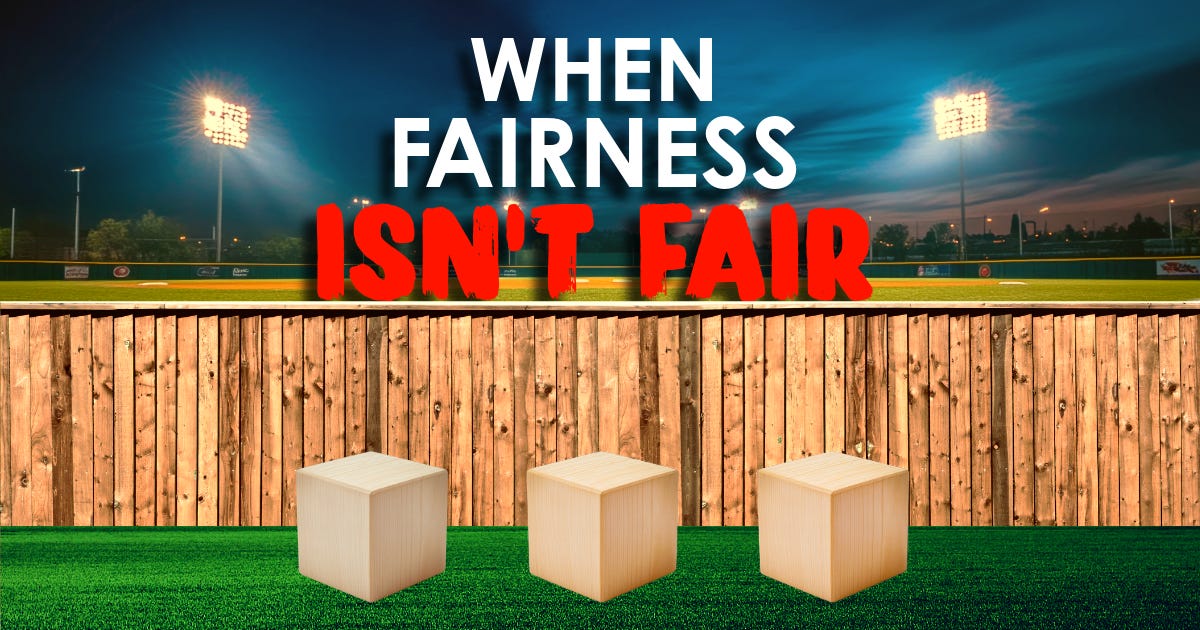
Imagine this popular image of three people standing behind a tall fence trying to watch a baseball game. One person is tall enough to see over the fence easily. One person can almost see but not quite. The third cannot see the field at all. If fairness means everyone gets the same wooden box to stand on, then the tallest person now sees even better. The middle person might finally catch a glimpse. The shortest person may still see nothing.
Everyone received the same thing. Yet the experience is still unequal.
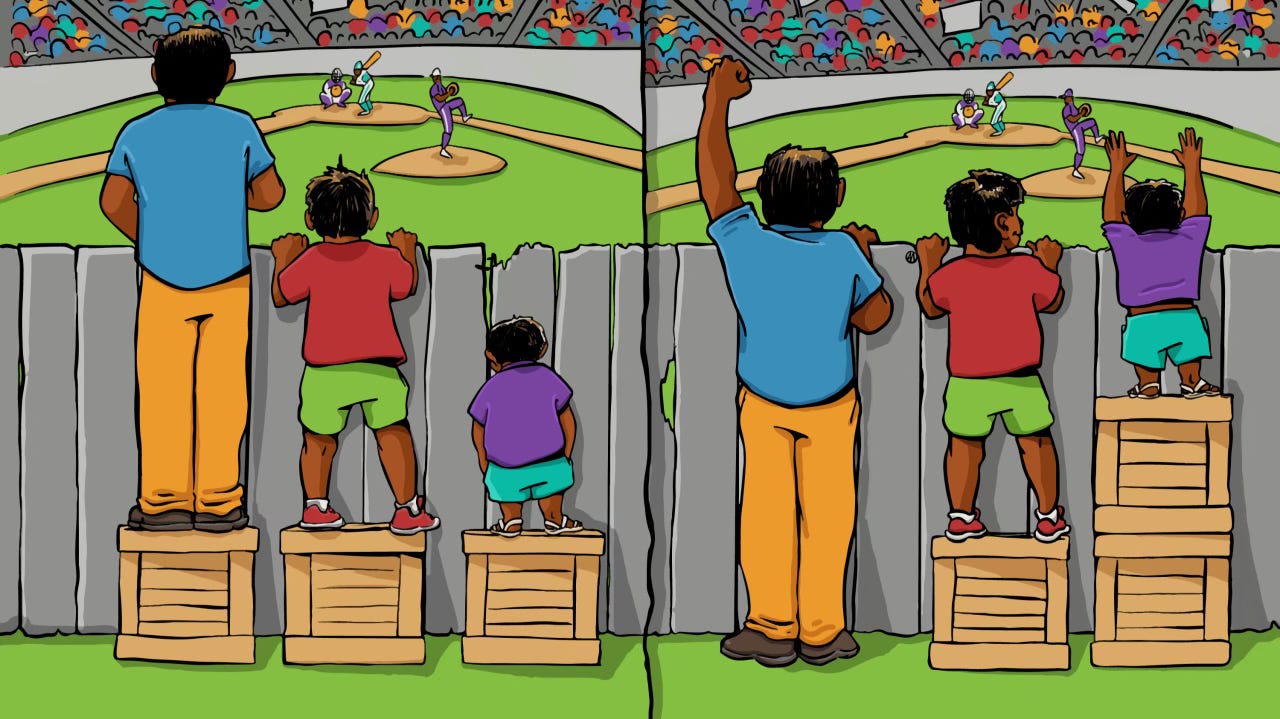
Sometimes fairness requires something different than sameness. Sometimes it requires attention to the conditions people are starting from and the barriers they face along the way.
This is where many public conversations become tense.
Some people emphasize the importance of consistent rules. They worry that once we begin adjusting support based on circumstance, fairness itself becomes unstable. Others point out that consistent rules applied to unequal conditions often reproduce the same disparities year after year.
Both instincts come from a desire for justice. One focuses on equal treatment. The other focuses on equal possibility. In practice, societies wrestle with both questions at the same time.
When a school district directs additional resources toward schools serving low-income neighborhoods, the goal is not to advantage some students over others. The goal is to create conditions where students who face additional barriers have a real chance to succeed.
When public health programs target communities with higher rates of illness, the intention is not to treat some people as more valuable. It is to respond to the reality that certain communities carry heavier burdens.
These decisions reflect a deeper question about what fairness means. Is fairness about identical treatment, regardless of circumstance? Or is fairness about creating conditions where people actually have the opportunity to flourish? Neither approach is simple. Both require humility. Both require careful conversation about goals, tradeoffs, and outcomes.
What becomes clear, however, is that fairness is more complicated than many of us were taught. Treating everyone the same can feel neutral. Yet neutrality in a landscape shaped by unequal histories often preserves the inequalities that already exist.
Paying attention to different starting points can feel uncomfortable. Yet ignoring those differences does not make them disappear.
As the United States moves toward a more diverse and interconnected future, these questions will only become more important. Communities will continue wrestling with how to design schools, policies, and institutions that are both consistent and genuinely fair.
And that may require us to hold two ideas at the same time. Sameness matters. But fairness sometimes asks us to look deeper than sameness.
An Invitation
If these ideas resonate and you want structured support to understand them, Project 2045 is hosting Skill Building cohorts in 2026 that teach the conversation skills white people need for this moment. It is a space to build capacity, deepen self-awareness, and strengthen the muscles required for a shared multiracial future.
Check out cohort details and apply here.
Conversation and action is how change begins.