


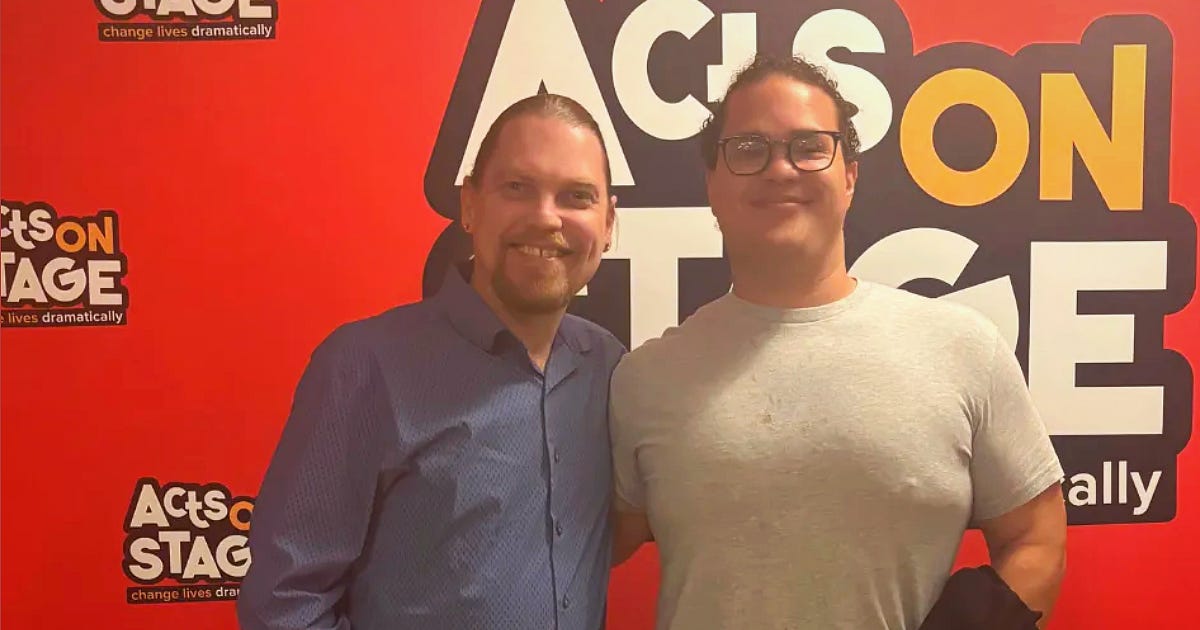
I was sixteen years old when my mom asked if we wanted to move in with her new boyfriend. What I didn’t yet understand was that she was pregnant and that this move was happening because they were going to have a child together. It may not have been the healthiest way to start a new family system, but it was what it was. And almost overnight, I became the older brother to a mixed-race baby boy.
I still remember the excitement I had. I took three buses to get to the hospital. I remember holding him as an infant—how small he felt, how instinctive the protectiveness was. TI was only home full-time for the first three years of his life before I left for college. I chose a school just a couple of hours away because I couldn’t imagine being too far from him. Even with a sixteen-year age gap, I felt a real sense of responsibility. And honestly, I was just so stinking happy to have a little brother.
As he grew, our relationship changed shape. We roughhoused until one day I realized he was getting too big for me to throw around anymore. I tried to stay interested in whatever he was interested in—his hobbies, his pursuits, the things that lit him up. Over time, something else emerged, too. Adulthood helps brotherhood move towards friendship. The quiet joy of being adults together, of sharing experiences and trust across years and distance.
He has been a constant source of love in my life. And while I’ve lived in a different state for almost all of his life, I’ve carried a deep sense of commitment to him and a constant yearning for closeness. Distance never diminished the bond.
I grew up in the shadow of some significant cultural moments. One of the most formative was watching the video of Rodney King being beaten by police officers and then watching those officers be found not guilty. That moment, for my generation, carried the kind of weight that George Floyd’s murder has carried for another.
I didn’t yet have language for systems or structural inequity. But I understood something was wrong. I understood that violence toward Black bodies was being normalized and dismissed. And once I started to become aware of this reality, I immediately applied it to my brother.
Some of my earliest engagements with conversations about race and culture came in college and in my early twenties. But I wasn’t part of communities that were especially willing, or able, to have those conversations well. What I remember most clearly from that time was a single, repeating thought:
This could be my little brother.
There is something deeply formative about trying to understand across fault lines when you have a personal stake in it. I’ve known many people whose views on race, immigration, sexuality, or culture didn’t change because of a compelling argument, but because love finally made the issue unavoidable.
It’s often the immigrant neighbor whose story stops being political. The gay co-worker whose wedding changes how you hear the debate. The cross-racial partner, spouse, or child who makes neutrality impossible.
We don’t usually stand with those who are vulnerable out of pure moral clarity. We do it because attachment and love rewires us. Because proximity breaks open our abstractions. Because someone we love becomes exposed, and suddenly the cost of silence feels higher than the cost of change.
For me, these national moments of racial tension have always landed close to home. When I see stories about policing, I think about my little brother being careful in a department store by himself. I think about him being pulled over. I think about the risks he carries that I never had to calculate in the same way. I think of the conversations his dad had to have with him to instruct him to live as Black in a world like this.
That’s not theoretical. That’s personal. And it is terrifying.
Demographic data tells us that somewhere around the year 2045, white Americans will no longer make up more than 50% of the U.S. population. White people will still be the largest single racial group, but no longer the majority. Sociologists sometimes call this a “majority-minority” country, though that phrase itself is awkward and revealing.
Being ready for that future with responsibility, courage, and integrity is the hope behind this project. People who identify as mixed race are now one of the fastest-growing demographic groups in the country. For many white families, 2045 already came. It is already at the dinner table. Already in family photos. Already wrapped up in love, fear, pride, and responsibility. It has come in the form of a daughter marrying a Hispanic man, a brother marrying a Black woman, or a grandchild or niece who is mixed race.
Race is not arriving as a theory. It is arriving as kin.
I don’t pretend to understand all the dynamics of being mixed race in America. What I’ve heard, consistently, is that it’s complicated—being told you’re not “enough” of one thing or not “enough” of another. In a culture that has long treated whiteness as the default, anything that isn’t fully white is often treated as not white at all.
My hope for the coming decade is that we will grow in our understanding of the unique dynamics of mixed-race identity, especially when one half of that equation is white. That understanding will require humility. It will require listening. And it will require white Americans to do some of our own work, rather than expecting others to carry it for us.
My little brother has been one of the most important people in my life. Though he’s sixteen years younger than I am, he has shaped how I see the world in ways I didn’t expect.
I may live long enough to see the demographic shift around 2045. He will almost certainly live in it for decades beyond that. I carry fears about what that world will look like. I also carry hope. And I know this much:
Love alone isn’t enough. Good intentions aren’t enough. Avoidance certainly isn’t enough. We need formation. We need courage. We need the willingness to stay present when conversations get uncomfortable, especially when they touch our own families.
This work isn’t abstract for me. It never has been. As we move towards 2045, it will no longer be for many of us. And that’s why it matters.