


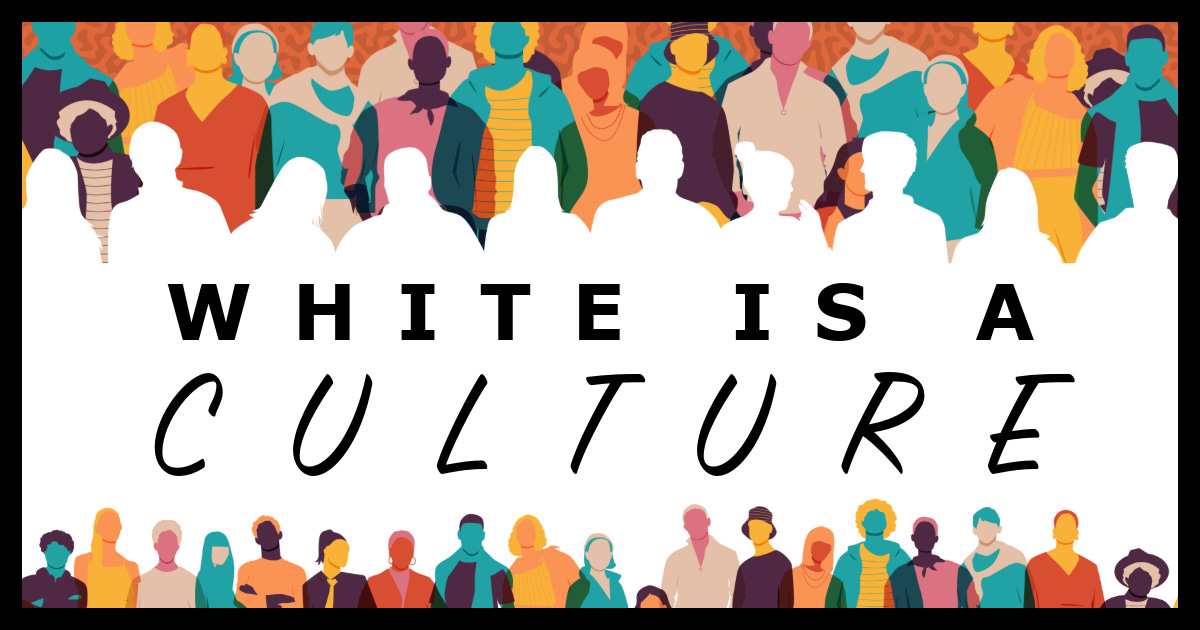
One of the most common responses I hear when talking about race is some version of, “I don’t really have a culture.” Sometimes people will say, “I’m just American,” or “My family is pretty normal.” What they usually mean is that they do not have a culture that feels particularly visible to them.
That is often how culture works when you are surrounded by it.
Imagine a fish swimming through water. If you asked the fish to describe water, it might struggle. Water is not something the fish visits. It is the environment in which the fish lives. It is so constant that it becomes invisible. Culture often works the same way. We tend to notice other people’s cultures much more easily than our own.
For many white Americans, culture can feel invisible because many of the assumptions, values, and norms associated with white culture have become the default settings of American society. We are taught in schools, reinforced in workplaces, reflected in media, and built into many of our institutions. When something is treated as normal for long enough, it can stop looking like culture and start looking like reality itself.
This is why I believe it is important to say something that can sound surprising at first: white is a culture.
To be clear, I am not saying all white people think alike, vote alike, or share the same experiences. Nor am I suggesting that white culture is the only culture in America. I am saying that there are patterns, values, assumptions, and ways of seeing the world that have historically shaped white American culture and continue to influence our way of life today.
White culture is difficult to define precisely because it is so broad and because it contains diversity within it. Yet there are several values that are often associated with dominant white American culture. These include a strong emphasis on punctuality and time management, productivity and efficiency, individual achievement, future planning, direct communication, competition, personal responsibility, and the belief that hard work should lead to success.
None of these values are inherently bad. The point is to recognize them as cultural values rather than universal truths. Every culture emphasizes certain things and downplays others. What feels obvious or natural to one group may feel strange or even unhealthy to another.
The challenge comes when one culture becomes dominant. A dominant culture tends to assume that its values are simply the way things are supposed to be. Its stories become the stories everyone learns. Its heroes become the heroes everyone studies. Its holidays become the holidays everyone recognizes. Its expectations become the expectations that schools, businesses, and institutions reward.
This is not unique to white culture. Any dominant culture tends to work this way. Throughout history, dominant cultures have rewarded those who understand their rules, reinforced the values that support them, and worked to preserve the systems that benefit them. That is simply how power operates.
The United States has been shaped primarily by white cultural norms for much of its history. As a result, many Americans of every race have learned to navigate those norms because they are the norms that often determine success in schools, workplaces, and public life.
At the same time, America has never been made up of only one culture. People bring different histories, traditions, values, and ways of understanding the world. Some cultures place greater emphasis on community than individual achievement. Some value relationships more than schedules. Some understand success through the lens of family obligation rather than personal accomplishment. Some prioritize harmony where others prioritize directness.
As our country becomes increasingly diverse, we have a choice. We can continue assuming that one cultural framework should define public life for everyone, or we can learn how to make room for multiple ways of being human. We do not have to pretend to abandon white culture because we cannot do it. But we do have to recognize that white culture is a culture. And learn that, while a dominant white culture has often pushed others to flex to it, our job is to learn to flex our cultural values to those outside of the dominant.
That means recognizing that our way is not the only way. It means learning to listen before assuming, adapting before demanding, and becoming curious about how others experience the world. In a nation where no single group will hold a majority, the future will belong to people who can move comfortably between cultures while building bonds across cultural differences. The first step in that journey is recognizing that white is a culture. It is the fishbowl we are swimming in.