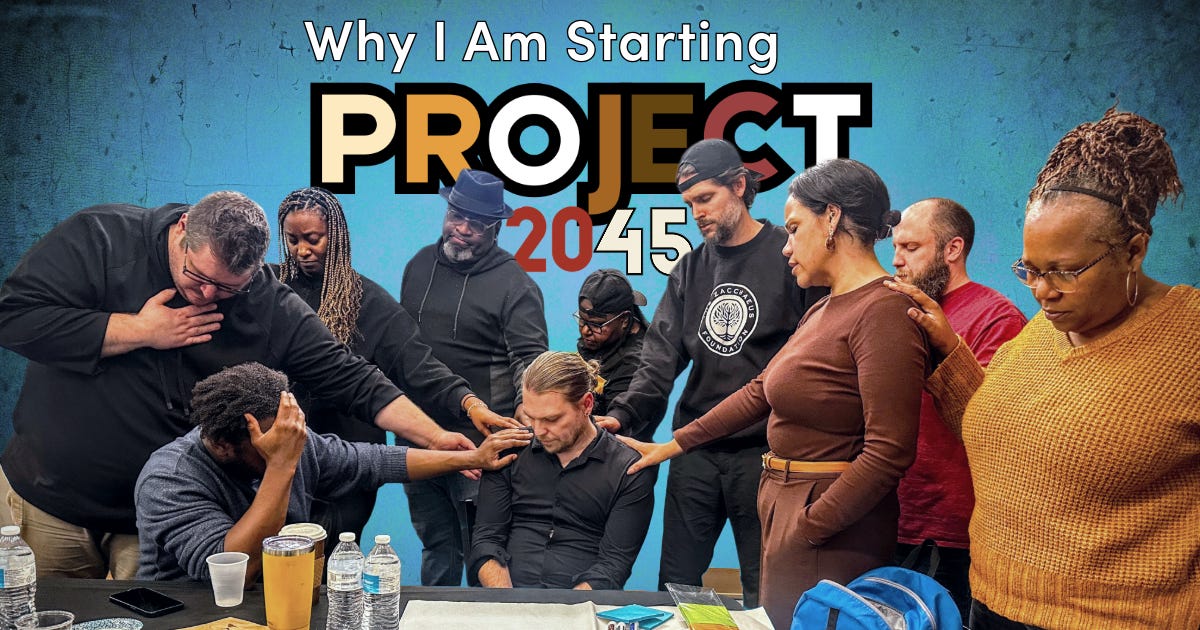
By around 2045, the United States will be a country where no single racial or ethnic group makes up a majority.
That reality is often framed as a statistic, a projection, or a political talking point. For me, it feels more like a slow-approaching horizon—visible now, unavoidable later. The question isn’t whether this future is coming. The question is whether we are becoming the kind of people who can inhabit it with responsibility, courage, and integrity.
Project 2045 begins with a recognition that the future does not wait for our readiness.
Demographic change in the United States is not a theory or an ideology. It’s happening in classrooms, neighborhoods, and workplaces, right now. And yet, many of us, especially white Americans, have not been formed for what this shift actually requires of us. We may support diversity in principle. We may want fairness and belonging for everyone. But when conversations about race, history, power, and difference become personal or uncomfortable, many of us lack the inner resources to stay present.
What I see, again and again, is not simply disagreement, but fragility. Fear. Withdrawal. An inability to tolerate discomfort without shutting down or lashing out.
That’s why Project 2045 is not about forecasting the future or winning arguments about it. It’s about preparation. Formation takes time. It takes repetition. It takes intentional practice long before the pressure is on. Waiting until 2045 or until conflict forces these conversations upon us is already too late.
This project exists because who we are becoming now will determine how we live together then.
Conversation that leads Toward Practice
Over time, I’ve become increasingly convinced that information alone does not change people.
We live in an era saturated with content. Books, articles, podcasts, panels, and social media posts about race are everywhere. Much of it is thoughtful and necessary. But knowing the right language or holding the right opinions does not automatically translate into the ability to navigate real relationships especially when stakes are high and emotions are close to the surface.
Too often, our public conversations reward speed, certainty, and performance. They train us to react, not to reflect. To signal belonging, not to build capacity.
Project 2045 is intentionally resisting that pattern.
Rather than centering commentary on current events, this work focuses on formation: storytelling that humanizes rather than abstracts, conversations that build relational muscle, and practices that help people remain grounded when things feel tense or unclear. It’s about learning how to speak honestly without posturing, how to repair when harm is done, and how to stay in the room when it would be easier to leave.
This is slower work. Quieter work. But it’s the kind of work that actually shapes who we are.
Doing Our Own Work, in Public and Over Time
Project 2045 is also rooted in a conviction about responsibility. Especially for white U.S. Americans.
This work cannot be outsourced. Too often, white people engage questions of race only when a crisis erupts, or rely on people of color to educate, correct, or absorb the emotional weight of our learning. Project 2045 is a refusal of that pattern. It is an invitation to take responsibility for our own formation, while remaining accountable to histories, voices, and experiences beyond our own.
My own racial autobiography is inseparable from this project. I know what it’s like to be afraid of saying the wrong thing. I know the instinct to stay quiet, to avoid conversations about race and culture altogether, to confuse silence with safety. I also know, because I’ve lived it, that avoidance doesn’t lead to neutrality. It leads to distance, fear, and unexamined power.
Project 2045 is not about presenting myself as an expert or arriving with answers. It’s about narrating the work honestly, practicing in public, and inviting others to do the same. It brings together the threads that have shaped my life and vocation: spiritual formation, storytelling, facilitation, and long-arc thinking about what it means to flourish together.
At its heart, this project is hopeful but not naïve. It trusts that people can grow and change, but only if we are willing to begin now, go slowly, and stay with the work overtime.
Project 2045 is an invitation to prepare. To practice. To become people capable of living into a more diverse America with responsibility, courage, and integrity.
This is Project 2045.
Thanks for reading! Subscribe for free to receive new posts and support my work.