


The core of our Skill Building Cohort is simple to say and hard to do: we are practicing becoming white people who are competent and confident having conversations about race and culture with other white people. Not experts. Not people with all the answers. Just people willing to initiate, to stay in the room, and to keep showing up for the Six Conversationsoutside of our group and inside our actual lives.
Recently, each person in the cohort checked in on how those conversations have actually been going out in the world — with a sibling, a coworker, a neighbor, a parent. I want to share what surfaced, because it says something true about all of us, not just the people in this particular group.
People are more open to this than we expected.
Almost every check-in included some version of surprise. Not that people agreed, not that the conversations were easy, but that the other person was willing to engage at all. Several in the cohort said they had built up a conversation in their head and instead found someone who simply hadn’t been asked before. Asked about race and culture specifically, and asked with real interest, by someone willing to sit in it with them.
The conversations themselves were not as hard as people feared.
This came up again and again. Not that these conversations are easy — they can still be uncomfortable, halting, imperfect. But the difficulty people had braced for, the blowup they could come, mostly didn’t happen. I say mostly because… yes… some did. What happened more often was slower, more ordinary, and more human than the stories we tell ourselves about what these conversations will be like.
People are willing to tell their story if we’re actually listening.
Cohort members kept describing the same thing: when they came with genuine curiosity instead of a point to make, the other person opened up. Not because they were persuaded of anything, but because someone finally wanted to hear their experience instead of correct it or perform for it.
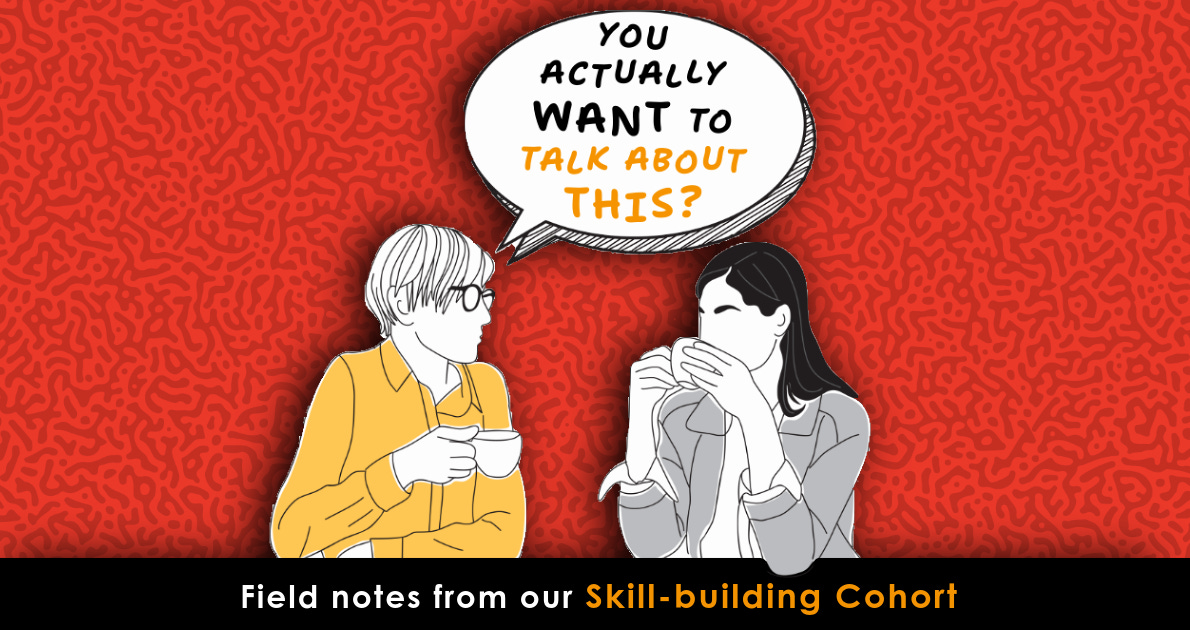
And one person said some version of, “They couldn’t believe I actually wanted to talk about this.”
That line has stuck with me. It’s not a small thing, and I don’t think it’s really about the individual conversations. I think it points to something we’ve all absorbed, whether we’d say it out loud or not: that conversations about race are supposed to be emotionally dangerous, that they inevitably lead to conflict, that the safest move is to avoid the topic altogether. Most of us didn’t choose that belief. We were handed it over years of misinformation.
What this group is finding is more complicated than “that belief is wrong.” Sometimes these conversations are hard. Sometimes they do go badly. That risk is real, and I don’t want to pretend otherwise. But what’s showing up over and over in these check-ins is something different: most people aren’t avoiding these conversations because they tried and got burned. They’re avoiding them because they the door looks heavier than it is, mostly because no one has shown us it opens.
This is not everyone’s experience. I want to be honest about that. Some conversations in this cohort have been genuinely difficult, and a few haven’t gone well at all. But the through-lines from this round of check-ins were clear enough that I wanted to name them here.
We still have real work ahead of us, in this cohort and beyond it. But I’m grateful for a group willing to test that fear against their actual lives, and to come back and tell the truth about what they found.