



For seventeen years, I worked at the same institution. I loved it. Still do and miss it most days. I assumed I would retire there. My vocational imagination was shaped inside those walls. I knew the rhythms, the politics, the pathways. It was fun and fulfilling.
Over time, as conversations about culture and justice surfaced and stalled, surfaced and stalled again, I began to recognize something I did not want to see. The kind of cultural growth it professed, and I believed was possible, was not going to take root there. Not in the ways I had come to understand it.
In his final book, Where Do We Go From Here: Chaos or Community Rev. Dr. Martin Luther King Jr. addressed the common question that often white folks ask who are awakening to cultural realities ask, “so what do I do?”
The question itself, when asked over and over to People of Color denotes that they are somehow responsible for our cultural growth and development. When, in truth, it isn’t on People of Color to decide what white people do about the problematic issues that stem from witness. We need to be responsible for answering the question, “so what do I do?”
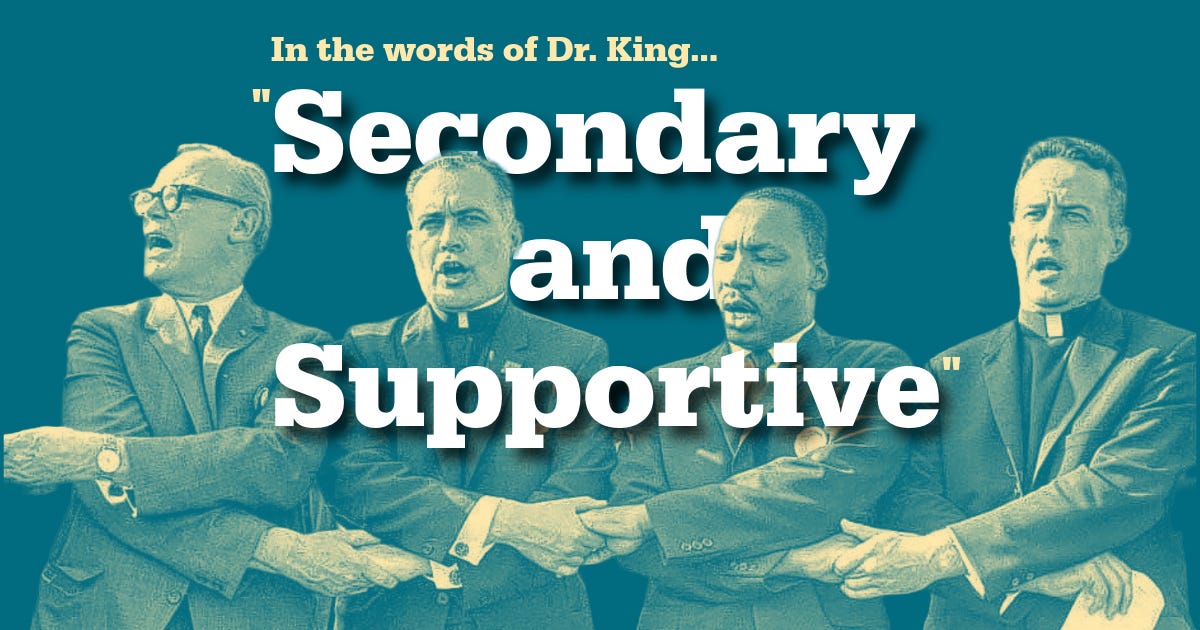
Dr. King had an answer that is surprisingly simple to understand but remarkably complex live in light of how we have been taught to think about being white in the world. King says, “white liberals must be prepared to accept a transformation for their role. Whereas it was once a primary and spokesman role, it must now become a secondary and supportive role.”
Secondary and Supportive.
What I did not understand at first was that believing it would cost me something.
This posture changed my life, employment, vocation, relationships, spending patterns, learning habits, and, more importantly, my self-understanding. Few things in our lived experience have prepared us to be secondary and supportive. We are raised to believe that by walking into the room, we have a valid opinion, expertise, or understanding.
First and Primary.
Secondary and supportive did not mean I simply changed my tone in meetings. It meant I could not build my future on being the primary voice in rooms where culture and justice were at stake. It meant the next professional move could not simply be the normal ones prescribed for me.
For the first time in my adult life, I felt professionally unmoored. If I was not climbing, not leading from the front, not shaping the institution in my image, then who was I vocationally? I had built competence around being first and primary. I had very little practice being secondary and supportive on purpose.
There was a season where I understood secondary without supportive. It looked like withdrawal. I stepped back, but did not yet know how to step in differently. I confused humility with disappearance. I told myself that if I just removed my voice, I was doing the work. In reality, I was protecting myself from the vulnerability of following. I am suspect of anyone with privilege who believes we can somehow deny or abdicate that privilege. By virtue of being white in the US American context we have privilege in every room we walk in whether we think we are denying it.
Eventually, I made a decision that clarified the posture. If I believed King, then my next role needed to reflect that conviction. I found work under the leadership of a Person of Color doing cultural work. Not adjacent to it. Not advising from a distance. Under it. In truth he needed a white man to be in rooms he knew would be adversarial. That shift did not make me a hero. It made me a learner again. I had to flex. My instincts were not final. My timing was not central. My voice was not always needed. I had to bring my skills, relationships, and access in service of someone else’s vision. But, I clearly had a role.
And I began to understand something I had previously missed. Secondary does not mean smaller. It means directional. Supportive does not mean silent. It means accountable.
I think stepping back and learning is an important step, but not the final one. We can truly bring all of our skills, gifts, talents, abilities, privileges, and wealth to the table in support of cultural initiatives and justice. The question is, are we willing to do so in the service of the causes of justice? How can we follow leaders who will inevitably think, act, and lead in ways that may not be intuitive for us?
Since then, several leaders have allowed me to practice this posture. Allowed is the right word. It has required work and patience on their part. Secondary and supportive is not a credential you claim. It is a trust that is extended.
The question “So what do I do?” no longer feels abstract to me. It feels personal.
I do not abdicate my privilege. I try to identify and leverage it.
I do not center my perspective. I begrudgingly situate it in a wider context.
I do not opt out. I show up — but not at the front where I so often want to.
It is still an identity struggle. For someone raised to believe that walking into a room automatically conferred authority, this has been the most disorienting and liberating shift of my vocational life.
And I am still learning how to do it.
-------------
I built a comfort zone around secondary and supportive. In truth it kept me in positions to know that I was genuinely of service to movements of culture and justice in way that were tangible.
I thought secondary and supportive was the final destination but as usually happens, it became a necessary posture for a deeper step of risk and vulnerability that was to come